|
The Lord Brings Victory Through Perseverance |
|
|
When we face terrible circumstances that are seemingly impossible to overcome, it is tempting to give in to despair and give up the fight. It is far more difficult to press on because it is the right thing to do and it must be done regardless of the cost or apparent certain defeat. Sir Winston Churchill, prime minister of the United Kingdom during World War II, echoed this idea in the face of the growing threat of Nazi Germany and the reluctance of Western powers to stop Adolph Hitler's aggression when he said:
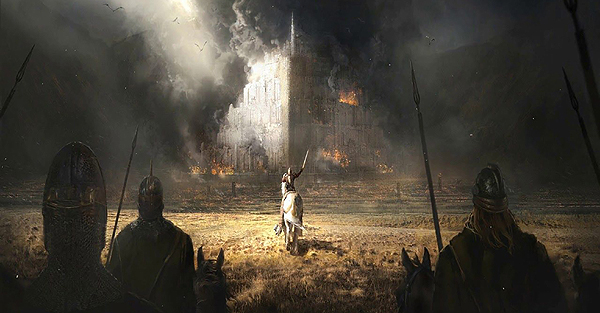
This view was reflected in Peter Jackson's 2003 cinematic rendition of J.R.R. Tolkien's The Lord of the Rings: The Return of the King, where Théoden, king of Rohan, received word from Gondor that Minas Tirith, its capital, was besieged by the forces of the Dark Lord Sauron of Mordor. Gondor was calling on Rohan to fulfill the Oath of Cirion and Eorl. This was a centuries-old agreement between the kingdoms of Gondor and Rohan promising an eternal bond of friendship that included coming to each other's aid when either kingdom was threatened by an invading force. Considering his small army and the enormity of taking on Sauron's forces, Théoden may have been tempted to stay home and not get involved. But he remembered the Oath and mustered the Rohirrim, the cavalry of Rohan. Riding with them was Lord Aragorn of Gondor and his companions Legolas and Gimli, all mighty warriors. That night at the Dunharrow Plateau staging area, as many riders of Rohan as could respond to the king's summons arrived, only about 6,000. Aragorn, Legolas, and Gimli departed from the camp to seek reinforcements. The soldiers of Rohan, not knowing this, started to murmur among themselves and wondered with crestfallen faces where they were going on the eve of battle, some concluding that they were leaving because there was no hope. Gamling, one of Théoden's lieutenants, said,
But with firm resolve in his eyes and voice, Théoden responded,
The following day, the Rohirrim arrived at Pelennor Field. A short distance away lay Minas Tirith with more than 50,000 orcs besieging it and smoke coming from parts of the city. Loud drums and shouts of expectant victory arose from the orcs as they were about to breach the gates with their battering ram. Théoden rode at the front of his army, delivering a rallying speech to rouse the courage and resolve of his men before leading them into battle. Then the horns of the Rohirrim were blasted and the order to charge given. Though the orcs vastly outnumbered Théoden's army, when they heard the horns blast and the cavalry fiercely bearing down upon them as one man, they fell back in terror and were overrun. The Rohirrim did enough damage to the enemy's forces to prevent the total destruction of Minas Tirith, providing enough time for Aragorn to arrive with his reinforcements to utterly destroy Sauron's army and save the city. Though Théoden himself valiantly fell with many of his men in battle, it was their willingness to endure in the fight against the seemingly unsurmountable that caused the forces of evil to weaken, be pushed back, and eventually be defeated. In writing this portion of the Lord of the Rings: The Return of the King (1955), J.R.R. Tolkien may have been inspired by one of the many historical accounts in the Bible when Israel faced an apparently overwhelming and undefeatable foe, and through perseverance and faith in God obtained deliverance and victory. In the middle of the 11th century BC, the Philistines dominated and oppressed the people of Israel (1 Samuel 13-14:1-23). Desiring freedom from Philistine rule, Israel made Saul their king, who declared independence by blowing the trumpet throughout the land and attacking and defeating the Philistine garrison in Geba through his son Jonathan. The Philistines gathered a multitude of soldiers as vast as the sand on the seashore to crush the rebellion, punish Israel, and re-enslave its people. The hearts of King Saul's soldiers melted with terror when they saw the multitudes of their enemy gathering to destroy them. Many of them hid themselves in caves, thickets, holes in the ground, cliffs, and cellars. Some of the men of Israel even fled across the Jordan River into the land of Gad and Gilead. But Jonathan did not flee or become paralyzed by fear, leading to inaction. He took the initiative, trusting God, and found a Philistine garrison at a strategic location. He told his aide, "Come and let us cross over to the garrison of these uncircumcised; perhaps the LORD will work for us, for the LORD is not restrained to save by many or by few." (1 Samuel 14:6) Jonathan pressed forward, with his aide closely following, and defeated the soldiers at the stronghold and turned the tables on the Philistines. As word got out of Jonathan's resolve and exploits, it aroused courage in the hearts of the rest of Israel's soldiers, who came out of hiding and rallied to the fight. God, through Jonathan, brought about a great liberation for Israel by granting their army the ability to be inspired to follow a brave, faithful leader and endure in the battle to take ground and defeat a much greater enemy. For many years, especially in Western nations such as the United States, we have seen the steady growth and strength of concerted attacks against the Judeo-Christian foundational principles that guided society, especially manifested in the increasing embrace of a culture of death through infanticide up to birth (even after) and the growing power of the Islamic-Marxist axis. They can appear as unbeatable foes besieging a country that once was a beacon of light for the whole world. There are many voices, some among Christians, who would say that it is hopeless to try to change anything since this world is not our home and that it is better to withdraw into our own enclaves and leave the corrupt world outside as we await the return of the Lord Jesus. These are voices not to be heeded, since doing so would diminish the beneficial influence believers in Christ should have in the world and embolden the increase of evil.
In the face of the powerful culture of death, it is good and right not to shrink back in fear and oppose this thick darkness by, for example, volunteering at a local Christian crisis pregnancy center, where the love of Jesus and the gospel message are shared, along with material support for babies, and their mothers and fathers. Many lives have been and continue to be redeemed through ministries such as this. Do not concede ground to the enemy of our souls through indifference, fear, and inaction. Let not the Islamic-Marxist axis with their anti-Christian worldview increase their control like a dark cloud over society without contest. It is a common saying that, "The only thing necessary for the triumph of evil is for good men to do nothing." Often wicked leaders, locally and nationally, are elected to office to promote evil policies and laws. Too many times, this happens because many Christians do not participate in the electoral process and vote for candidates that reflect more closely the biblical values they profess to hold. Believers in Christ must be involved and vote so that their voices may be heard. In addition to voting, those who are able should run for local and national positions of leadership so that righteous policies may be pursued and maintained and wicked ones thwarted. Things such as these allow for greater space and opportunities for us to be the salt that Jesus wants us to be in the world, a preserving agent of what is good until He returns to take us home into his eternal kingdom (1 Thessalonians 4:13-18). They allow us to be light in a dark world that points to Jesus and the salvation He grants to anyone who trusts in Him. No matter how dark or impossible it may look in the world, continue to take the initiative and run the race set before us with firm resolve and confidence in the Lord (Hebrews 12:1-2). Receive the gift of perseverance that God grants for the asking (Romans 15:4-6), and celebrate in the permanent victory He will bring through His Son Jesus when He returns (Revelation 22). |
|
 |
|
| What Is the Gospel? | What Must I Do to Be Saved? | Home | Contact Us | Return | |