|
The Joy Giving Brings by Rolaant McKenzie |
||
|
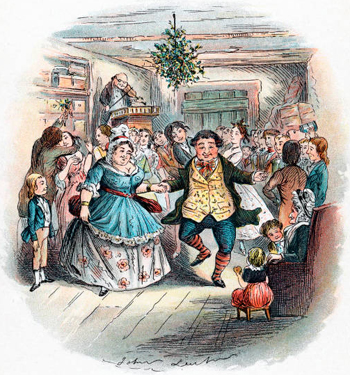
The greatest discoveries in life sometimes come from realizing certain truths that, on the surface, seem counterintuitive. An example of this can be seen in Charles Dickens' (1812-1870) novella, A Christmas Carol (1843), where an ill-mannered miser named Ebenezer Scrooge is visited on Christmas Eve night by the spirits of Christmas Past, Present, and Future, who were sent to warn him to repent of his way of life or face terrible, eternal consequences, as had his late business partner Jacob Marley. The ghost of Jacob Marley preceded the visitation of the three Christmas spirits. He came weighed down with chains, cash boxes, keys, padlocks, ledgers, deeds, and purses made of steel. Marley's focus in life was the acquisition and jealous protection of wealth. His disregard of grace, mercy, and charity toward the poor forged the heavy burden he now carried in the afterlife. Marley realized too late that mankind was his business, not the greedy pursuit of money, and he would forever experience no rest or peace but the "incessant torture of remorse." He urged Scrooge to heed the lessons of the three Christmas spirits and change his ways, or he would carry an even heavier burden of suffering in the afterlife. When the spirit of Christmas Past came, he took Scrooge back to the days when he was a young man being apprenticed under Albert Fezziwig, a jovial, kind, and generous man who had great affection for his employees. It was Christmas Eve, and Fezziwig excitedly called for closure of the business. The shutters were put over the windows, the door shut, and the furniture cleared away to make room for dancing.
There was mirth aplenty as the music played, and staff, family, and friends danced and enjoyed the feast set before them. Scrooge remembered that Fezziwig probably only paid three or four pounds for this wonderful occasion, but the happiness he gave his employees and guests was as great as though it cost a fortune. Giving generously of his time and resources brought great joy and satisfaction to Fezziwig's heart. This review of his past helped Scrooge understand the benefits of being a good and generous employer. He came to regret mistreating his poor clerk, Bob Cratchit, and resolved in his mind to treat him better. After the visitation of this spirit and the spirits of Christmas Present and Future, Scrooge changed from being a mean miser to a kinder, gentler man. When he awoke that morning, he was overjoyed not to have missed Christmas Day. He arranged to anonymously have a humongous turkey sent as a gift to Bob Cratchit's home for Christmas dinner. The following day, Scrooge significantly raised Cratchit's salary and offered to be a help to his family and especially to be like a second father to his seriously ill son, Tim. Because of his generosity, Tim was able to get the proper medical treatment he needed and did not die. Scrooge's newness of life was apparent to all around him. Instead of Christmas being a humbug to him as before, he now knew how to keep it well and experience the joy that comes from giving. Many believe that the relentless pursuit and preservation of wealth will bring them happiness. But like Marley and the old Scrooge, they discover that it does not bring security or satisfaction but creates barriers between family and friends. It replaces virtues like empathy and generosity with greed and materialism, and it produces an underlying fear that destroys peace and contentment. The word of God provides a dire warning to those who make the pursuit of wealth their primary focus in life:
Contrary to human conventional wisdom, Jesus taught that it was more blessed to give than to receive (Acts 20:35). Fezziwig lived according to this way, and it brought him joy that spread to others, security, and satisfaction. It strengthened the bonds between family and friends, and it provided overall peace and contentment no matter the challenges of life. But the greatest joy that came from giving was when God, seeing humanity's lost state through sin inherited from Adam's disobedience (Romans 5:12-21), gave His Son Jesus, the Righteous One, His Servant, to suffer and die in the place of sinners so that all who trust in Him will not face the wrath of God.
The Father did not hold back His Son, but gave Him as a ransom so that human beings separated from Him because of their sin may be fully forgiven, reconciled to Him, and receive eternal life (Matthew 20:28; Romans 8:32). Great joy comes to the heart of the Father when anyone repents and receives the gift of His Son (Luke 15:7).
Scrooge resolved to know Christmas in his heart, the joy of being kind and generous, and keep it throughout the year. In a similar fashion, all who have received the gift of salvation through Jesus Christ can share the gospel of God's grace, be generous, kind, and charitable to others, and truly know the joy giving brings. |
||
 |
||
| What Is the Gospel? | What Must I Do to Be Saved? | Home | Contact Us | Return | ||