|
Genuine Faith or Talisman Faith? |
|
|
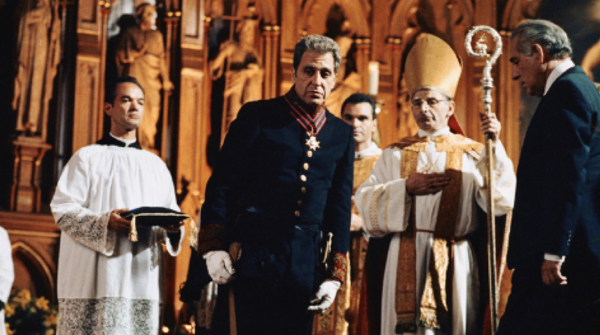
Within the Italian mafia culture, affiliation with the Roman Catholic Church is common. Mafia bosses would attend church to maintain cultural ties, keep up favorable social appearances in the community, and sometimes seek spiritual absolution for their sins and protection from divine retribution without abandoning their criminal lifestyle. An illustration of this can be seen in The Godfather, which was a trilogy of American crime drama films released in 1972, 1974, and 1990. The films followed the rise of the fictional Italian-American mafia Corleone family, starting with the patriarch, Vito, and continuing on with his youngest son, Michael, who became his successor. In the third film, Michael Corleone is nearly 60 years old. He considers his wealth and power and feels tremendous regret in the ruthless way he had amassed it. In an attempt to assuage his guilt, Corleone donates millions to charitable causes, for which he is named Commander of the Order of St. Sebastian at St. Patrick's Cathedral in New York City. He also works to move his money out of his criminal enterprises into a legitimate international real estate company called Immobiliare. Michael Corleone travels to Rome to visit Cardinal Lamberto to discuss the Immobiliare deal. As they talked, he perceived him to be an honest, pious man and felt great affection for him. Corleone believed him to be a "true priest." Lamberto encouraged Corleone to make a confession. As he pondered his life, Corleone tearfully said that he had betrayed his wife and himself and that he killed men and ordered men to be killed. But what tore most at his soul was ordering the murder of his brother, Fredo. Before giving him the sacramental absolution, Lamberto told him, "Your sins are terrible, and it is just that you suffer. Your life could be redeemed, but I know you do not believe that. You will not change." Corleone left Lamberto feeling that his sins were covered by his absolution. But he continued to order the killings of rival mafia bosses and others whom he believed were a threat to his family. But the consequences of his activities led to an attempt on his life that mistakenly killed the one he loved most, his daughter Mary. Corleone viewed her as the only pure and clean thing in his life, so he kept her out of "the family business" and unaware of and innocent of his criminal activities. Her death destroyed his life, and years later he died a broken man. Like some real-life mafia bosses and those depicted in films like The Godfather, many of the people of Judah just before the Babylonian exile (586 BC) clung to the belief that as long as the temple was there and they entered its gates to worship the Lord, they were immune from the consequences of their unrepentant sins. They deceived themselves into thinking that they could worship and seek the favor of other gods, oppress and plunder the stranger, the fatherless, and the widow, shed innocent blood for material benefit, and still be protected from divine punishment. God sent the prophet Jeremiah (627-574 BC) to confront this false belief and call on all holding it to repent, change their ways, and truly follow the Lord:
The people of Judah had wandered far from God and had created a culture of corruption in their judicial system. Perjury and the manipulation of the law to steal, kill, and destroy others, especially the weak and defenseless of society, were commonplace. A culture of death was accepted, where for the sake of convenience and material prosperity, the people would shed innocent blood in the form of sacrificing their sons and daughters to false gods such as Baal and Molech (Jeremiah 32:33-36). The people at the temple trusted in the building and religious activity, like a person would cling to a talisman to ward off evil. Jeremiah warned them that their trust was unfounded and that these things would be of no help to them without repentance from their evil ways. Unfortunately, his words were not heeded. The people believed the false prophets who encouraged them in their rebellion against God. They continued to believe they had license for their sinful activities because of the religious rituals performed at the temple until devastation fell upon the kingdom of Judah by the hands of Nebuchadnezzar, king of Babylon, who laid siege to Jerusalem and eventually destroyed the city and the temple. Those who survived the sword, famine, and disease were led into exile. Like the people of Judah during the time of Jeremiah the prophet, many people today rely on their religious activities as a charm that they believe allows them license to live in sin against God and not be held accountable in the afterlife. They may go to church on Sunday morning, put an offering in the plate, sing a few hymns, read some passages of Scripture, say a few prayers, and believe in their hearts that they are "delivered" to live according to their sinful attitudes and desires (Jeremiah 7:9-10). They profess to be Christians, but then they go out to live a life that is indistinguishable from that of an unbeliever.
Jesus' shed blood on the cross was never meant to be used as a talisman to continue living a life of sin. Its purpose was to redeem us from our sins and make us His own people, zealous for living righteously before God (Titus 2:11-14). Genuine faith in Jesus Christ leads to repentance and a regenerate life that seeks to be faithful to God and His word. Do you have genuine faith or talisman faith?
|
|
 |
|
| What Is the Gospel? | What Must I Do to Be Saved? | Home | Contact Us | Return | |