|
The Undiscovered Country by Rolaant McKenzie |
|
|
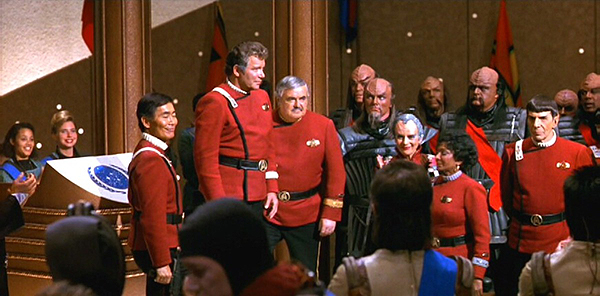
Star Trek is a popular science fiction television series that ran from 1966 to 1969. It had, and continues to have, a significant fan following, which has led to the creation of other popular spinoff Star Trek series. In 1991, the crew of the original series was involved in the last of six theatrical releases called Star Trek VI: The Undiscovered Country. The plot of the story involved two great powers, the United Federation of Planets and the Klingon Empire, which for generations had had a hostile relationship that sometimes bordered on full-scale war. At this time, ecological devastation on Kronos, the Klingon homeworld, and the destruction through over-mining of Praxis, its sole moon and key source of energy production, brought the Klingon Empire to a position where it could no longer afford conflict with the Federation. Being confronted with the prospect that their empire would end in fifty years unless drastic change was made, the Klingon Chancellor Gorkon sought a rapprochement with the Federation. For the first time in their history, these two powers were on the verge of reaching a lasting peace with each other. However, hardliners on both sides worked together behind the scenes to thwart the peace efforts and return to the previous hostile relationship. The USS Enterprise, under the command of Captain James T. Kirk, was tasked with escorting Chancellor Gorkon's battlecruiser, Kronos One, to Earth for peace talks. During a state dinner on the Enterprise, Gorkon, referencing a line from William Shakespeare's Hamlet, offered a toast to "the undiscovered country -- the future." However, when he returned to Kronos One, he was assassinated by what appeared to be two men in Federation spacesuits. Azetbur, Gorkon's daughter, succeeded him as chancellor. She resisted the suggestions of her advisors to attack the Federation and instead called for the continuance of the peace talks at a neutral location called Khitomer. An effort was made to assassinate the Federation president, but it was thwarted in time by Kirk. At the end of the story, in response to Azetbur's question, "What's the meaning of all this?" he said:
With the conspirators and their plot neutralized, the Khitomer Accords were signed, fulfilling Gorkon's dream of the United Federation of Planets and the Klingon Empire embarking on the road to the "undiscovered country" of peace and cooperation. The comfort of the status quo and fear of change often act as strong ropes tying people to belief systems contrary to the gospel. Family, friends, job, business, and tradition provide strong incentives to remain in the system. This is reminiscent of those described by the apostle John, who realized that Jesus was the Messiah but chose not to confess Him because it was more comfortable to have the approval of men over the approval of God (John 12:42-43). Many Jews saw the increasing persecution of their brethren who believed in Jesus. They were put out of the synagogue, the center of Jewish life and community, and experienced ostracism from their families and friends and the loss of jobs and businesses. This acted as a strong hindrance against Jews believing in Jesus and greatly tempted those who had to return to Judaism. The Book of Hebrews was written around 65 AD to exhort Hebrew Christians not to turn away from the "undiscovered country" but to continue in the grace and truth of Jesus Christ (John 1:14-18). These early believers gathered together not only to worship the Lord and receive the teaching of the apostles but also to support each other, especially those made destitute after being cast out of their homes and community (Acts 4:32-35). People presented with and convicted by the gospel message in Islamic countries such as Iran, Somalia, and Pakistan face similar pressures to avoid embracing the change the "undiscovered country" brings, including the threat of death. One example of this can be found in Jesus Freaks, Volume II (2002), a book written by DC Talk and the Voice of the Martyrs. It included the 2001 story of Asif of Pakistan. Immediately after suffering a serious motorcycle accident that broke his leg, a woman emerged from the crowd on the street, knelt beside him, laid her hand on his leg, and prayed in the name of Jesus that it be healed. Asif's leg immediately straightened and was completely healed, and he was able to walk home. Sometime later, the woman came to Asif again and gave him a Bible. He never saw her again. As Asif read the Bible, he started to question what he was taught as a Muslim. Perplexed, he took his questions to the leader of his local mosque, who became angry with him and, with others there, locked him in a room. They forced deadly poison down Asif's throat and left him in the room, hoping that he would die before he accepted Jesus as his Savior. Barely alive, Asif called out to Jesus. A bright light filled the room, and he started to be revived. Asif saw a vision of Jesus, and he surrendered his life to Him. Before daybreak, he managed to escape and went home. He told his parents what had happened, but they banished him from the house. Asif went to a larger city and connected with a pastor, who discipled and baptized him. Though he suffered beatings, imprisonment, and threats of death, Asif's love for his people caused him to share the gospel message whenever and wherever he had the opportunity. Sometimes even pride or the long investment of time makes it difficult for some to believe the gospel of Christ. People find rationales for remaining in what they know deep down is not really true. Saving face, whether consciously or unconsciously, takes the front seat and delegates the truth to the back. Sometimes there is a reluctance to leave a false system of belief because it is hard to imagine life outside of it. Fellowship with Christians would seem like entering a foreign culture. But those who have believed the Biblical gospel and passed out of death into life find that there is an affinity with other believers, regardless of previous backgrounds or ethnicity (John 5:24; 1 John 1). While there are differences of belief in peripheral doctrines that do not affect salvation, the Holy Spirit, who resides in all true believers, connects them in a genuine bond of fellowship.
Fear and apprehension should not prevent fellowship with the community of saints worldwide, for there is joy in being a part of a much larger family. This kind of family is described in Revelation 7:9-10:
Some who embrace the gospel may be inclined to leave their former religion behind and not look back. This is an easy thing to do, because even a person experiencing the effective salvific grace that comes with belief in the true and Biblical gospel may be tempted not to want to have anything to do with any aspect of their former life. It may be tempting to burn that bridge behind while moving forward. But such an inclination should be resisted. When God brought Paul out of Judaism to belief in the gospel, he did not leave behind his Jewish brethren. His deep desire was to go back to them and share the good news of the gospel with them so that they might be saved. Romans 10:1-4 clearly illustrates this:
As you cross the bridge of Christ to grace, peace with God, freedom, salvation, and the unity of Christian fellowship, do not burn the bridge behind you. Remember those on the other side and love them enough to tell them about the life-saving gospel, and extend to them an invitation to the "undiscovered country." |
|
 |
|
| What Is the Gospel? | What Must I Do to Be Saved? | Home | Contact Us | Return | |